A practitioner's playbook
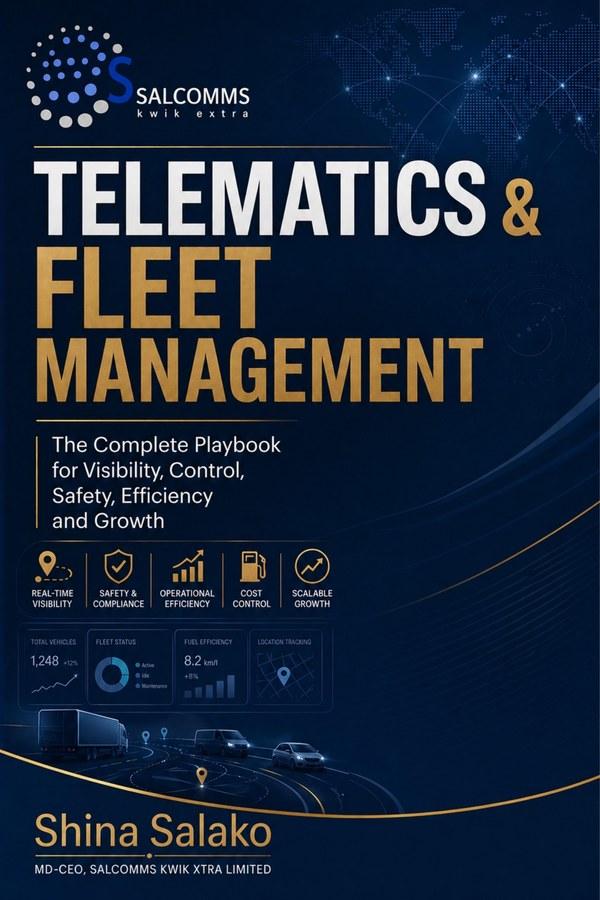
Telematics & Fleet Management.
The operating playbook for fleet leaders in emerging markets — visibility, control, safety, and profitability.
By Shina Salako · MD/CEO, SALCOMMS KWIK XTRA LIMITED · 2026
The opening scene
A transport manager calling drivers one by one to find out who actually left the yard. Fuel slips stacked on the desk, half of them unreadable. Two trucks that will not start. By midday, a vehicle reportedly broken down on the Lagos–Ibadan expressway — and nobody can say with certainty where it is.
This is not a failing operation. It is a typical one. And the book is built around what to do about it.
Who this book is for
For the people who carry the daily weight of a fleet — and the leaders who answer for it at the top of the house.
Fleet operators
If you run the fleet
Fleet managers, transport heads, control-tower controllers, operations leaders responsible for delivery reliability, asset uptime, and cost-per-kilometre across 3PL, FMCG, beverages, oil and gas, mining haulage, courier, or government fleets.
Executive sponsors
If you answer for it
COOs, supply-chain directors, CFOs, and business owners whose vehicles are central to revenue — and who are quietly unsure whether the fleet is generating, protecting, or leaking margin.
Practitioners
If you build the discipline
Telematics buyers and implementers; consultants; analysts; the next generation of fleet leaders who want to build operations that are not just functional, but intelligent, accountable, and scalable.
What is inside
Approximately 270 pages. Three parts. 27 chapters. Nineteen practitioner appendices.
A practical playbook built across fifteen years of telematics and logistics operations — written from the seat of the embedded service provider whose teams sit inside the cargo-owner's premises and produce the daily reports that let leadership manage their transporters with independent visibility.
The book is grounded in real engagements — including the twelve-year Guinness Nigeria fleet management programme — and built to be read cover-to-cover by new leaders or referenced chapter-by-chapter by working practitioners.
- PART IFoundations — devices, connectivity, trips, geofences, the control tower, ETA, dwell, route compliance, data integrity.
- PART IIOperating disciplines — driver behaviour, maintenance, fuel, dispatch, customer SLAs, vendor governance, compliance, incident response, reporting.
- PART IIIStrategy, scale & future — cost-per-km, ROI, the maturity model, team and KPI design, AI, scaling, the seven-layer Fleet Operating System.
- APPENDICESA practitioner toolkit — KPI dictionary, RACI matrix, transporter scorecard, control-tower routine, sample SOPs, incident protocols, the extended Guinness Nigeria case study, and a six-month practice plan.
From the book
Three sentences that frame the work.
“Lack of effort is rarely the problem in fleet operations. Lack of evidence almost always is.”
Part I — Foundations
“We do not solve the problem. We make it visible enough that the parties who own it can solve it together.”
The operating credo
“A modern fleet is not a department. It is an operating system — built bottom-up, in seven layers, over years.”
Chapter 27 — The Capstone
The First Look
Read the opening of the book before you buy.
A free PDF — the foreword, the introduction, the full first chapter, the first 1,000 words of the Guinness Nigeria case study, and the maturity-model framework. Roughly 40 pages. Enough to know whether the rest of the book is for you.
No marketing emails. Your address joins a quarterly practitioner note from the author — one substantive piece per quarter, nothing more. Unsubscribe in one click.
Send me the First Look
Free PDF · 40 pages · delivered to your inbox in under a minute.
- Foreword + introduction + the operating credo.
- Chapter 1 in full — Fleet Management & Telematics Foundations.
- Opening of the Guinness Nigeria case study (first 1,000 words).
- The maturity-model framework as a one-page diagnostic.
Corporate email preferred · one-click unsubscribe.

The author
Shina Salako
MD/CEO, SALCOMMS KWIK XTRA LIMITED · 15+ years in telematics and logistics operations
Shina Salako is the founder and managing director of SALCOMMS KWIK XTRA LIMITED, a telematics service provider whose operating model is built on embedded teams at client sites. SALCOMMS analysts and operators sit inside the cargo-owner's premises, install the tracking devices on every third-party transporter's vehicle before commercial operations begin, and produce the daily business management reports that allow the client's leadership to manage transporter performance with independent visibility.
In 2014 he pioneered and managed Guinness Nigeria's first fleet management programme. Twelve years later, SALCOMMS is still embedded in that operation.
He is affiliated with PowerFleet, a global telematics platform operating in over fifty countries, and is a certified Maxwell Leadership Team member.
The framework the book builds toward
The seven-layer Fleet Operating System.
A modern fleet is not a department. It is an operating system — deliberate, documented, measurable, built layer by layer. Each layer depends on the stability of the one beneath it.
Build bottom-up. Investing in higher layers before lower layers are stable wastes money — the most common failure mode in this industry, and the one this book is built to help operations avoid.
Free interactive diagnostic
Where does your fleet operation actually sit on the seven layers?
Honest answers, in ten minutes. The assessment scores your operation against the same seven-layer Fleet Operating System this book builds toward.
- Eighteen practitioner questions across the seven FOS layers.
- Your maturity stage on the 1-to-5 scale used in Chapter 20.
- Your weakest layer named, with a recommended next move.
- An optional follow-up: a two-hour facilitated session with the author.
Self-paced · No login
- 1Answer 18 questions honestly — score each statement 1 to 5.
- 2See your maturity stage and weakest layer immediately.
- 3Enter your email if you want the written report and the next-move guide.
No marketing list. Results sent once. Your data is not shared.
Work with the author
Speaking, training, consulting — for organisations ready to build the operating system.
The book is the foundation. The work that follows it sits in three forms. Each is designed for a different conversation a serious fleet operation needs to have at the right moment.
Keynote
Executive keynote & conferences
A 60-90 minute keynote — Building the Fleet Operating System: What twelve years at Guinness Nigeria taught us — for executive audiences, industry conferences, board offsites, and strategy retreats.
Enquire about speaking →Training
In-house masterclasses & programmes
Six-week practitioner cohorts for fleet management teams, control towers, and operations leadership — Cargo-Owner and Transporter programmes, plus in-house cohorts for organisations training eight or more from one team.
See the training programmes →Consulting
Fleet Operating System assessment & embedded service
Start with the free 10-minute self-diagnostic, then deepen into a 10-day written assessment of your fleet against the seven-layer FOS. Most engagements continue into SALCOMMS embedded telematics service.
Take the free self-diagnostic →Read the book. Then have the conversation.
The book exists to make a difficult conversation easier. Read it. If what is in it matches the operation you are running — or trying to build — talk to us.